
Air Duct Cleaning: Repair or Replace? How Auburn Homeowners Decide
Most Auburn homeowners ask us whether their ducts need cleaning, repair, or full replacement, and the honest answer is that one of those three is almost always the right call while the other two are a waste of money. Cleaning is the right choice when the ducts are dirty but structurally sound. Repair is right when a joint has separated, flex duct is crushed, or insulation wrap has failed. Replacement is right far less often than it gets sold. The trick is knowing which condition you’re actually in before anyone starts quoting you.
We’re Auburn Air Duct Cleaning Co, and we look at ducts for a living. Here’s the diagnostic framework we use, so you can use it too. If you’d rather not climb into a crawlspace in the rain, call (877) 792-5686.
Why the Order of Operations Matters in Auburn Ducts
A leaky duct system loses conditioned air every hour it runs, and that loss often outweighs the penalty from accumulated debris. That’s the part most quotes get backwards. If a system is leaking, cleaning it first means you’re paying to clean air paths that then leak the clean air back into the crawlspace.
Auburn homes sit in a wet, mild climate where crawlspace ductwork spends most of the year in damp, cool air. That environment punishes flex duct in particular. The outer jacket gets soft, the insulation wrap sags, and joints that were taped at install start to peel. When we open a crawlspace here, we’re looking for moisture damage as much as dust.
The correct sequence most of the time looks like this:
- Inspect the full run, including every joint and connection you can reach.
- Test for leakage if the system is older or you’ve noticed uneven room temperatures.
- Seal or repair the mechanical failures first.
- Clean the now-sealed system so the debris you dislodge has nowhere to escape.
- Sanitize if there’s microbial growth, typically after a moisture event.
Sealing before cleaning isn’t a sales line. It’s the only order that makes the cleaning worth paying for.
The Three-Condition Model Technicians Use to Triage a System
When a technician walks into a home, they’re sorting the system into one of three categories, and that sorting determines the recommendation. It’s a triage, not a sales menu.
Condition 1: Contamination (cleaning candidate)
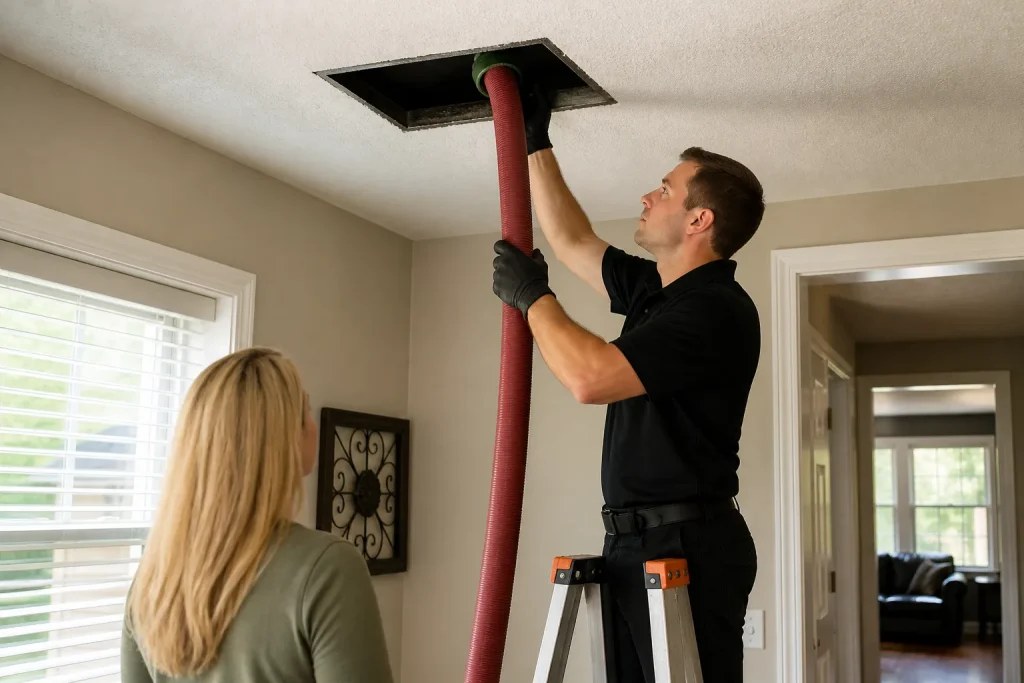
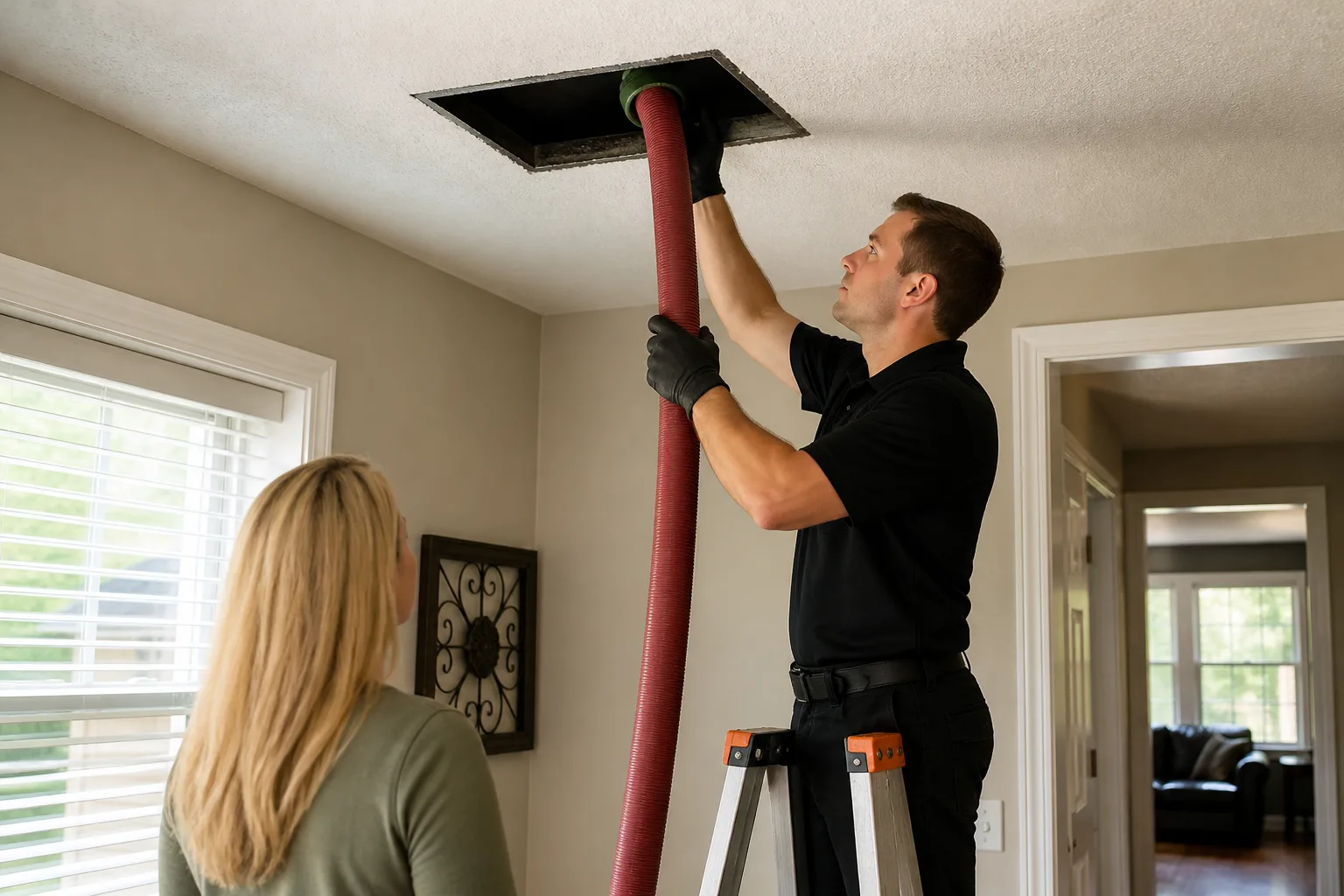
The structure is sound but the interior is loaded with dust, debris, or microbial growth. Ducts here respond to professional rotary contact cleaning, which is what our Rotobrush system is built for. The brush contacts the duct wall and dislodges what’s stuck, while a HEPA-rated Nikro vacuum captures the debris instead of blowing it back into the room.
Condition 2: Mechanical failure (repair candidate)
The contamination may be moderate, but joints are disconnected, flex runs are crushed, or the insulation wrap has degraded. Cleaning alone won’t fix these. Air still bypasses the filter path, and dust gets pulled in through the unsealed joint. This is the condition most often missed, because it’s invisible from the register.
Condition 3: Age and configuration failure (replacement candidate)
The duct material itself is failing. That’s different from being dirty or loose. This is where replacement pencils out, and it’s the smallest bucket of the three.
What Duct Leakage Testing Actually Tells You
Leakage testing pressurizes the duct system and measures how much air escapes before it reaches the registers. In practice, a technician caps the registers, connects a calibrated fan to the system, and reads the airflow needed to hold a set pressure. The result tells you how much of your conditioned air is leaking into a crawlspace instead of a bedroom.
For Auburn homes with long crawlspace flex duct runs, leakage is usually concentrated at three places:
- Boot connections where the duct meets the floor register.
- Trunk-to-branch takeoffs where the main line splits to rooms.
- Flex duct joints where sections were coupled at install.
The longer and more convoluted the run, the more joints, and the more places air can escape. A house with a simple central return and short runs leaks far less than one where flex duct snakes through a low crawlspace to reach a far bedroom. If a technician doesn’t test or at least inspect joints before recommending cleaning, ask why.
When Duct Repair Is a Better Investment Than Cleaning
Some conditions cleaning simply cannot address, no matter how good the equipment is. If you see any of the following, repair should be the conversation before cleaning:
- Crushed flex duct. A collapsed section chokes airflow to the rooms downstream. Cleaning a crushed duct does nothing for the room it feeds.
- Disconnected joints. A gap between duct sections pulls unfiltered crawlspace air straight into the supply path.
- Degraded insulation wrap. When the outer sleeve is torn or worn through, the duct sweats and the system loses efficiency even when it’s clean.
- Sagging duct runs. Low spots collect moisture and debris; the sag itself is a mechanical problem.
We see these regularly on older Auburn crawlspace installs. The good news is that repair and sealing are typically a fraction of the cost of replacement and can add years of functional life to a system that’s structurally intact. This is where our Duct Repair & Sealing service does the work that a clean-and-leave competitor can’t.
The Age and Material Thresholds Where Replacement Makes Sense
Replacement is the right call when the material has reached the end of its service life. The thresholds we use:
- Fiberglass duct board past roughly 20 years. If the interior surface is deteriorating, the fibers themselves become part of what’s circulating.
- Flex duct with a brittle outer jacket. When the jacket cracks instead of flexing, sealing it becomes a losing game.
- Asbestos-era rigid duct. Older homes may have duct material that predates modern standards, and disturbing it requires proper containment. This is remediation-level work, which is why we bring in Abatement Technologies equipment for jobs where containment matters.
If a system is failing on two or three of these at once, replacement starts to pencil out. If only one is present, repair or seal usually still wins on cost.
How to Get a Decision-Neutral Assessment
Homeowners understandably worry that a company will recommend whichever service has the higher margin. The best defense is asking the right questions before the recommendation is made. A technician who is assessing condition, not selling a menu, will welcome them.
- “Can you show me what you’re seeing?” Before-and-after photos of your own ducts, not stock images, are the bare minimum.
- “What’s the leakage before and after?” If they can’t measure it, they can’t back the claim.
- “Which condition are we in: contamination, mechanical failure, or material end-of-life?” A good technician can name it directly.
- “What happens if we clean first?” If the answer is “we’ll see later,” the assessment isn’t finished.
When to call a pro: honestly, most of this assessment requires getting into a crawlspace with testing equipment. That’s not a weekend job, and the conditions are easy to misdiagnose from the register alone. The scale of the problem is often bigger than a shop vac can fix.
Related services in Auburn: air duct cleaning, HVAC cleaning, and dryer vent cleaning all tie into the same airflow system. If the ducts are being opened up, it makes sense to look at the whole picture. And no, we don’t find it funny when a homeowner mentions the mysterious sock that ends up in a return duct. (We’ve all lost a sock, but the duct is the last place it should turn up.)
The Bottom Line
Cleaning, repair, and replacement each have a clear place in Auburn duct systems. Cleaning is for contamination. Repair is for mechanical failure like crushed flex, disconnected joints, and degraded wrap. Replacement is for material that has reached end-of-life, usually fiberglass board past roughly 20 years or brittle flex with a cracking jacket. Get the order of operations right: inspect, test, seal or repair, clean, and sanitize where needed.
One flat price per system, agreed before work starts, and before-and-after photos of your own ducts is a reasonable standard to expect from any company you hire. Ask for it.
If you’re in Auburn and need help, Auburn Air Duct Cleaning Co offers free estimates. Our technicians have up to 15 years of experience, and we use professional-grade equipment from brands like Rotobrush and Nikro, plus air quality solutions from Honeywell and Aprilaire when a filtration upgrade makes sense. We also handle duct repair and sealing under the same roof, so you’re not managing two contractors. Call (877) 792-5686. We answer 24/7. Fast dispatch from 7am to 7pm, Sunday through Friday.
You can also visit Auburn Air Duct Cleaning Co to see the full range of what we do.
Frequently Asked Questions
Air duct cleaning in Auburn is typically priced per system, not per vent, and the final price depends on the system’s size, accessibility, and condition. Any quote that starts with a per-vent number is worth questioning, because the real work is per system. Call (877) 792-5686 for a free estimate on your home.
If the ducts are dirty but structurally sound, cleaning is the answer. If joints are disconnected, flex duct is crushed, or the insulation wrap has failed, repair comes first. A technician can identify which condition applies by inspecting the full run, including joints and crawlspace connections. Call (877) 792-5686 to schedule an inspection.
Very low quotes usually skip inspection, skip sealing, and price per vent to make the number look small. Once a technician is on site, the price often grows. The fair standard is one flat price per system, agreed in writing before work starts, with before-and-after photos of your own ducts. Call (877) 792-5686 for a written estimate.
Most homes don’t need duct cleaning on a fixed schedule. It makes sense after a renovation, after a new HVAC install, after a moisture event, or when allergies and dust patterns suggest contamination. If your ducts are structurally sound, the interval can be years, not months. Call (877) 792-5686 and we’ll tell you honestly whether you’re due.
Written by the team at Auburn Air Duct Cleaning Co.
Need Air Duct Cleaning Help?
Call Auburn Air Duct Cleaning Co - the local pro we connect you with is licensed and insured, here with fast help in Auburn.
(877) 792-5686